
Debt Snowball vs Debt Avalanche Calculator
Debt Snowball vs Avalanche Calculator
Add your debts, pick an extra monthly payment, and compare three payoff strategies side by side — Snowball, Avalanche, and your own Manual order. Everything updates instantly and never leaves your browser.
Your debts
Add your first debt to begin comparing repayment strategies.
Credit cards, loans, medical bills — anything with a balance and an interest rate.
Extra monthly payment
Money you can put toward debt beyond everyone's minimum. This is what the strategies fight over.
Reset
Live summary
Add at least one debt to see your comparison.
Strategy comparison
Financial insights & recommendation
Payoff timeline
Manual order uses the priority you set by dragging debts in the list, or the ▲▼ buttons. It won't change until you reorder them.
Monthly payoff schedule
| Month | Debt | Begin balance | Interest | Principal | Payment | End balance | Status |
|---|
Export & share
Assumptions, formulas & limitations
How each month is calculated: Monthly interest = remaining balance × (APR ÷ 12). Principal paid = payment − interest. Any extra payment beyond minimums goes entirely to the strategy's current target debt; once that debt hits zero, the freed-up money moves to the next one the same month.
Assumptions: Interest compounds monthly · minimum payments stay fixed · no new debt is added · payments are made on time · APR stays constant · extra payments apply immediately.
Limitations: Real lenders may use daily interest, promotional APRs, penalty fees, or changing minimum payments — actual results can differ. This tool provides educational estimates only, not financial or legal advice.
Privacy: All calculations run locally in your browser. Nothing is transmitted or stored online.
💜 FREE • PRIVATE • NO SIGN-UP • INSTANT COMPARISON
Debt Snowball vs Avalanche Calculator
Our Debt Snowball Calculator helps you compare the debt snowball and debt avalanche methods using your actual debts, interest rates, minimum payments, and extra monthly payment. See estimated payoff time, total interest, debt-free dates, and potential savings side by side so you can make a more informed repayment decision based on your own numbers.
Designed for people who want to compare different debt repayment strategies before deciding how to prioritize their payments.
Private by Design
Calculations run in your browser, so you can compare repayment strategies without creating an account.
Two Strategies
Compare debt snowball and debt avalanche using the same debt information and payment budget.
Detailed Results
Review projected payoff time, interest paid, total payments, and debt-free dates.
Practical Insights
Understand the trade-offs between faster psychological wins and potentially lower interest costs.
👇 Ready to compare your debt payoff strategies?
Add your debts, enter their balances, APRs, and minimum payments, then add any extra monthly payment you can afford. The calculator will compare the two strategies using your inputs.
Important: Results are estimates based on the information you enter and the repayment assumptions used by the calculator. Actual interest charges, minimum payments, fees, payment timing, and payoff dates can vary by lender and account terms. This calculator is for educational and planning purposes only and is not financial, legal, or tax advice.
📑 QUICK NAVIGATION
Table of Contents
Explore the debt snowball vs avalanche calculator, understand how both debt repayment methods work, compare their potential costs and timelines, and learn how to interpret the results before choosing a strategy.
💜 Use the calculator with your own debt balances, APRs, minimum payments, and extra payment amount to compare both repayment strategies under the same assumptions.
What Is the Debt Snowball Method?
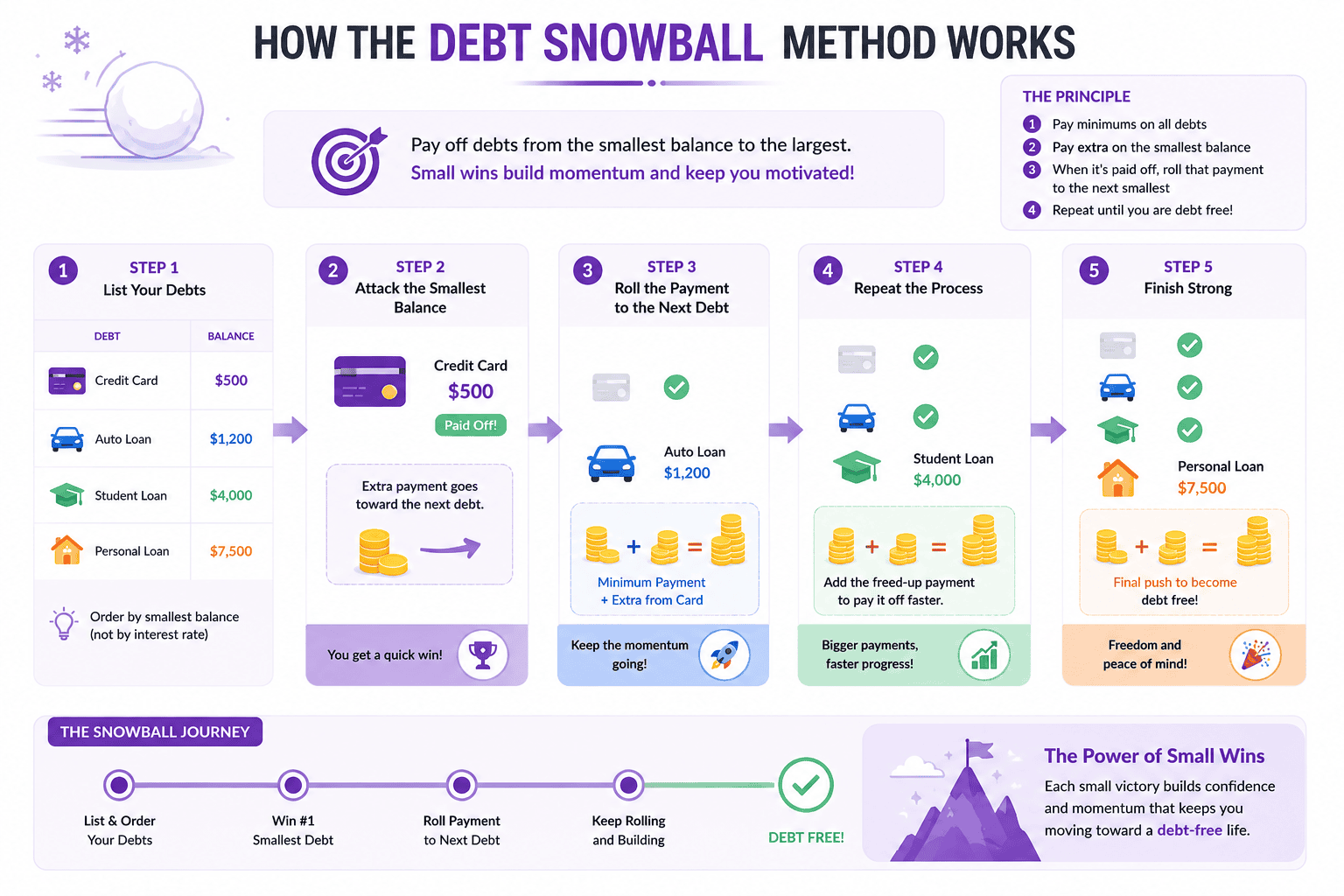
The debt snowball method is a debt repayment strategy that focuses on paying off your smallest outstanding balance first, regardless of the interest rate. You continue making the required minimum payments on your other debts while directing any available extra payment toward the smallest balance.
Once the smallest debt is completely paid off, the payment that was being used for that debt is added to the next smallest balance. The process continues from one debt to the next, creating progressively larger payments as individual debts disappear.
The main idea behind the snowball approach is not necessarily to minimize total interest. Instead, it is designed to create visible progress by removing smaller debts sooner. For some people, seeing an account reach a zero balance can provide useful motivation to continue working toward becoming debt-free.
Focus on the Smallest Balance
Extra money is directed toward the debt with the lowest current balance.
Quick Visible Wins
Smaller balances may be eliminated sooner, giving you measurable progress.
Roll Payments Forward
After one debt is paid off, its available payment is added to the next debt.
Keep Minimum Payments
Minimum payments on the remaining debts continue while the target debt receives the extra amount.
💡 Simple Example
Imagine you have three debts with balances of $500, $2,000, and $6,000. With the snowball method, the $500 balance becomes the first target. After it is paid off, the payment previously assigned to that debt is rolled into the $2,000 balance. Once that debt is cleared, the larger combined payment moves to the $6,000 balance.
When Can the Snowball Approach Make Sense?
The snowball method may appeal to people who value quick milestones and a simple repayment order. Paying off smaller balances can reduce the number of active debts and make the overall repayment plan feel easier to manage. However, it does not automatically produce the lowest interest cost. If a larger debt has a substantially higher APR, prioritizing the smaller balance first could result in more interest than an interest-focused strategy.
Important: The snowball method is a repayment strategy, not a guarantee of faster or cheaper debt repayment. Your actual results depend on your balances, interest rates, minimum payments, extra payments, fees, and whether additional debt is added during repayment.
What Is the Debt Avalanche Calculator?
The debt avalanche method is a debt repayment strategy that prioritizes the debt with the highest interest rate first. Instead of starting with the smallest balance, you continue making the required minimum payments on your other debts while directing available extra money toward the debt charging the highest APR (Annual Percentage Rate).
Once the highest-interest debt is paid off, the money that was being used for that debt is rolled into the next debt with the highest remaining interest rate. This process continues until all qualifying debts are paid off.
The main goal of the avalanche approach is to reduce the amount of interest accumulated during repayment. When balances, rates, minimum payments, and extra payments are otherwise comparable, targeting the highest APR first can result in lower total interest than prioritizing a lower-interest debt simply because its balance is smaller.
Highest APR First
Extra payments are directed toward the debt with the highest interest rate.
Focus on Interest Cost
The strategy aims to reduce interest accumulation by attacking higher-rate debt sooner.
Roll Payments Forward
After one target debt is eliminated, its payment can be redirected toward the next highest-rate debt.
Potentially Lower Interest
Prioritizing higher APR balances can reduce the amount of interest paid over the repayment period.
💡 Simple Example
Suppose you have three debts with balances of $500 at 8% APR, $2,000 at 18% APR, and $6,000 at 25% APR. The avalanche method would prioritize the $6,000 debt because it has the highest interest rate. After that debt is paid off, the strategy moves to the 18% debt and then the 8% debt, assuming the repayment assumptions remain unchanged.
Why Can the Debt Avalanche Calculator Save Interest?
Interest generally accumulates based on the outstanding balance and applicable interest rate. By directing extra payments toward a higher-rate debt, the strategy attempts to reduce that expensive balance sooner. This can lower the amount of future interest compared with putting the same extra payment toward a lower-rate debt while leaving the higher-rate balance outstanding.
The actual savings depend on your individual balances, APRs, minimum payments, payment timing, fees, and other account terms. That is why comparing both strategies using your own debt information is more useful than assuming one method will produce the same result for everyone.
⚠️ One Important Trade-Off
The avalanche method may not always produce the quickest visible win. A high-interest debt can have a large balance, so it may take longer before an account reaches zero. For someone who finds smaller milestones more motivating, the snowball method may feel easier to follow even if it costs more interest under the same assumptions.
Important: The avalanche method is designed to prioritize interest rates; it is not a guarantee of a specific savings amount or payoff date. Actual results depend on the information entered and the terms of your individual debts.
Debt Snowball vs. Debt Avalanche Calculator: Compare Both Methods
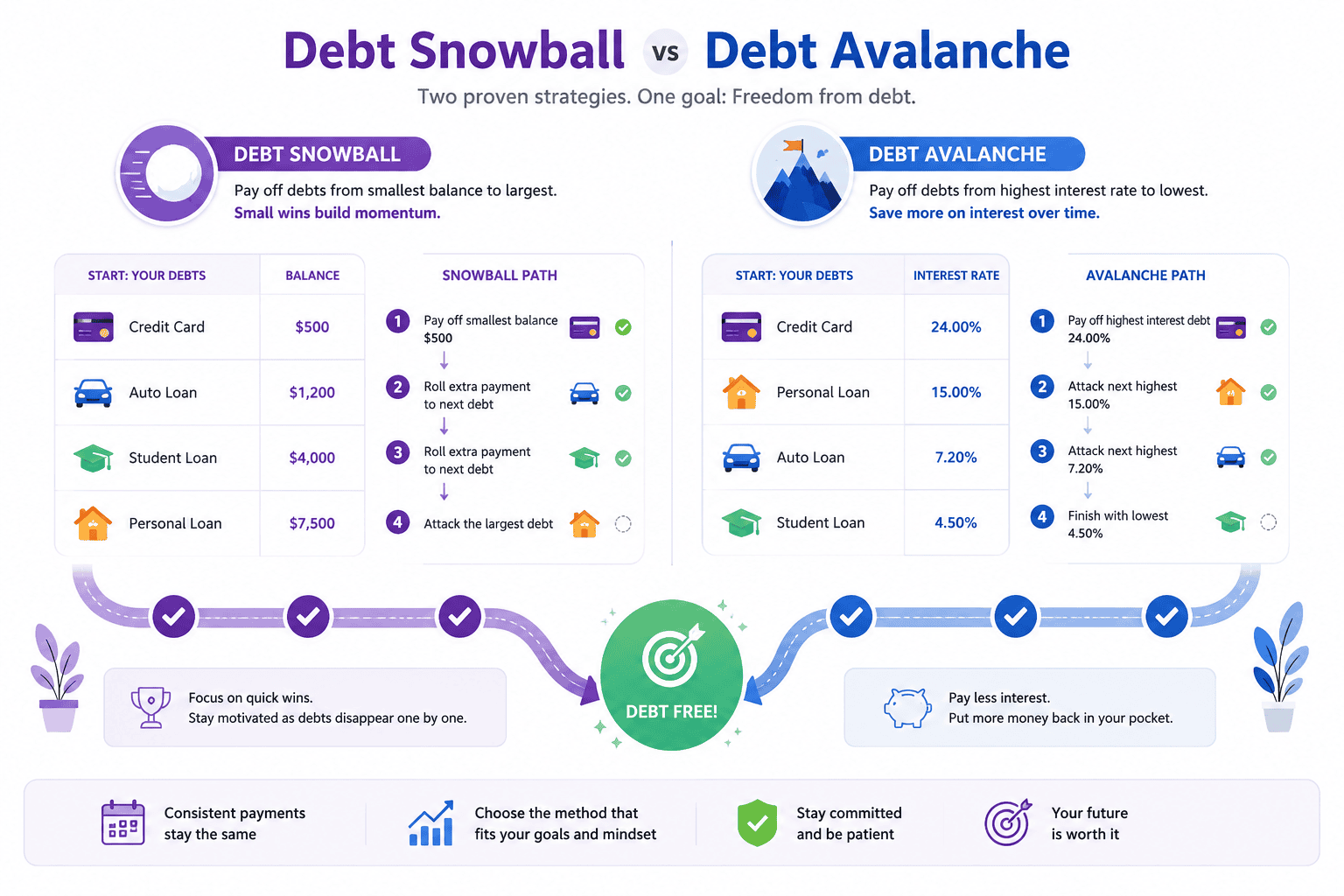
Our Debt Snowball vs Avalanche Calculator helps you compare the debt snowball and debt avalanche methods by showing how each strategy prioritizes your debts. Both methods direct extra payments toward one target debt at a time, but they use different rules to decide which debt comes first.
The snowball method prioritizes the smallest balance, while the avalanche method prioritizes the highest interest rate. Because these priorities can produce different repayment orders, the total interest, payoff timeline, and individual debt milestones may also differ.
Debt Snowball Calculator
Smallest balance first
Put your extra payment toward the debt with the lowest balance while continuing the required minimum payments on your other debts.
Primary focus: Reduce the number of outstanding debts and create smaller, visible milestones.
Debt Avalanche Calculator
Highest APR first
Put your extra payment toward the debt with the highest interest rate while continuing the required minimum payments on the other debts.
Primary focus: Reduce the amount of interest that can accumulate on higher-rate debt.
| Factor | ❄️ Snowball | ⚡ Avalanche |
|---|---|---|
| First target | Lowest balance | Highest APR |
| Main objective | Create quick payoff milestones | Reduce interest cost |
| Smallest debt paid first? | Usually yes | Only if it also has the highest APR |
| Highest-rate debt first? | Not necessarily | Usually yes |
| Potential interest cost | Can be higher | Often lower when assumptions are equal |
💡 Which Debt Payoff Method Is Better?
There is no single answer that is best for every person. If your priority is minimizing interest under the same repayment assumptions, the avalanche method generally has the mathematical advantage because it targets the highest APR first.
If your priority is creating early milestones and reducing the number of active debts quickly, the snowball method may be easier for you to follow. The most useful comparison is therefore based on your actual balances, APRs, minimum payments, and available extra payment rather than a generic recommendation.
🧮 Why the Repayment Order Matters
Consider two debts: one has a $1,000 balance at 8% APR, while another has a $5,000 balance at 25% APR. The snowball method would normally target the $1,000 balance first because it is smaller. The avalanche method would target the $5,000 balance first because its interest rate is much higher.
Neither strategy changes the amount you initially owe. What changes is where your extra payment is directed. Over time, that repayment order can affect interest accumulation and when individual debts reach a zero balance.
Compare Debt Snowball vs Avalanche
The difference between the two strategies depends on your actual debts. Enter your balances, APRs, minimum payments, and extra payment above to compare estimated payoff time and interest for both approaches.
Note: The comparison is an estimate based on the assumptions used by the calculator. Actual results may differ because of interest calculation methods, payment dates, fees, changing rates, new charges, and creditor-specific terms.
How the Debt Snowball vs Avalanche Calculator Works
Our Debt Snowball vs Avalanche Calculator compares two different ways of prioritizing multiple debts. Instead of looking only at your total balance, it evaluates each debt individually and models how your payments could be applied under both the snowball and avalanche strategies.
You provide information such as each debt's balance, APR, minimum payment, and any additional amount you want to put toward debt each month. The calculator then applies the selected repayment strategy month by month and estimates when each debt and your overall debt could reach zero.
1. Enter Your Debts
Add each debt with its current balance, APR, and required minimum payment.
2. Add Extra Payment
Enter the additional amount available each month beyond the required minimum payments.
3. Compare Strategies
The calculator models both snowball and avalanche repayment orders using the entered debt information.
4. Review the Results
Compare estimated interest, payoff time, total payments, and debt-free dates.
🔢 How the Debt Snowball vs Avalanche Calculator Is Modeled
Each repayment cycle begins with the outstanding balance and applicable interest. The required payment is then applied to the debt according to the calculator's repayment rules. Any available amount above the required minimum payments is directed toward the current target debt based on the selected strategy.
When a target debt is completely paid off, the payment amount that was previously going toward that debt becomes available for the next target. This payment rollover is an important part of both the snowball and avalanche approaches because it allows the amount directed toward later debts to grow as earlier balances disappear.
📌 What the Debt Snowball vs Avalanche Calculator Compares
Estimated number of months required to eliminate the modeled debt.
Estimated interest accumulated during the modeled repayment period.
An estimated date based on the payment assumptions entered.
Shows the estimated difference in interest between the two strategies.
⚠️ Why Your Actual Results May Differ
This calculator produces estimates rather than a statement of what a lender will charge. Actual results can vary because creditors may calculate interest differently, apply payments on different dates, change minimum-payment requirements, charge fees, adjust interest rates, or use terms that are not represented by the calculator. New purchases or additional borrowing can also change the repayment timeline.
🔍 Why the Debt Snowball vs Avalanche Calculator Is Useful
A debt payoff calculator can show you the mathematical consequences of different payment priorities, but the numbers are only part of the decision. Comparing the snowball and avalanche results side by side lets you see the potential trade-off between reducing high-interest costs and reaching smaller debt milestones sooner. You can then choose a repayment approach that fits both your financial situation and your ability to stay consistent.
Calculation note: Results are based on the debt information and payment assumptions entered into the calculator. The tool does not access your creditor accounts or verify lender-specific terms.
What Is the Debt Snowball Calculator?
Our Debt Snowball Calculator helps you understand how the debt snowball method works by focusing your extra payment on your smallest outstanding balance first, while continuing to make at least the required minimum payments on your other debts.
Once the smallest debt is paid off, the payment amount that was being used for that debt is rolled into the next-smallest balance. Over time, the amount directed toward the next debt can grow, creating the "snowball" effect.
The main appeal of the snowball strategy is not necessarily that it minimizes interest. Instead, it creates earlier payoff milestones that can make a multi-debt repayment plan easier to see and follow. For some people, eliminating a small balance quickly can provide useful momentum to continue with the larger debts.
Focus on the Smallest Balance
Rank your debts from the lowest outstanding balance to the highest.
Keep Minimum Payments Going
Continue making the required minimum payment on every other debt.
Roll the Payment Forward
After one debt is eliminated, redirect its payment toward the next target.
Repeat Until Debt-Free
Continue the process until all modeled debts have been paid off.
💡 Simple Example
Imagine you have three debts with balances of $500, $2,000, and $6,000. Under a basic snowball approach, the $500 balance becomes the first target regardless of whether another debt has a higher interest rate.
After the $500 debt is eliminated, the payment previously directed toward it can be added to the payment for the $2,000 debt. When that debt is eventually paid off, the available payment can then be directed toward the $6,000 balance.
⚖️ Potential Advantages and Trade-Offs
✅ Potential Benefits
- Creates early payoff milestones.
- Can simplify the order in which debts are targeted.
- May provide a stronger sense of progress.
- Can be easier to follow for people who prefer visible short-term wins.
⚠️ Important Trade-Off
Because the snowball method prioritizes balance size rather than interest rate, it may result in more interest being paid than an avalanche strategy in some situations.
🧮 Debt Snowball Calculator vs. a Debt Payoff Calculator
A snowball debt calculator can help turn the strategy into a measurable repayment schedule. Instead of relying only on the order of your debts, you can see estimated payoff dates, interest costs, monthly progress, and how payment rollovers affect later balances. Our debt snowball vs avalanche calculator goes one step further by allowing you to compare those results with the avalanche method using the same debt information.
📌 A Practical Point to Remember
The snowball method is a repayment strategy, not a guarantee of faster or cheaper debt repayment. Its effectiveness depends on your balances, interest rates, minimum payments, extra payment amount, and ability to maintain the plan. Comparing the actual numbers can help you understand whether the strategy fits your circumstances.
How the Debt Avalanche Method Works
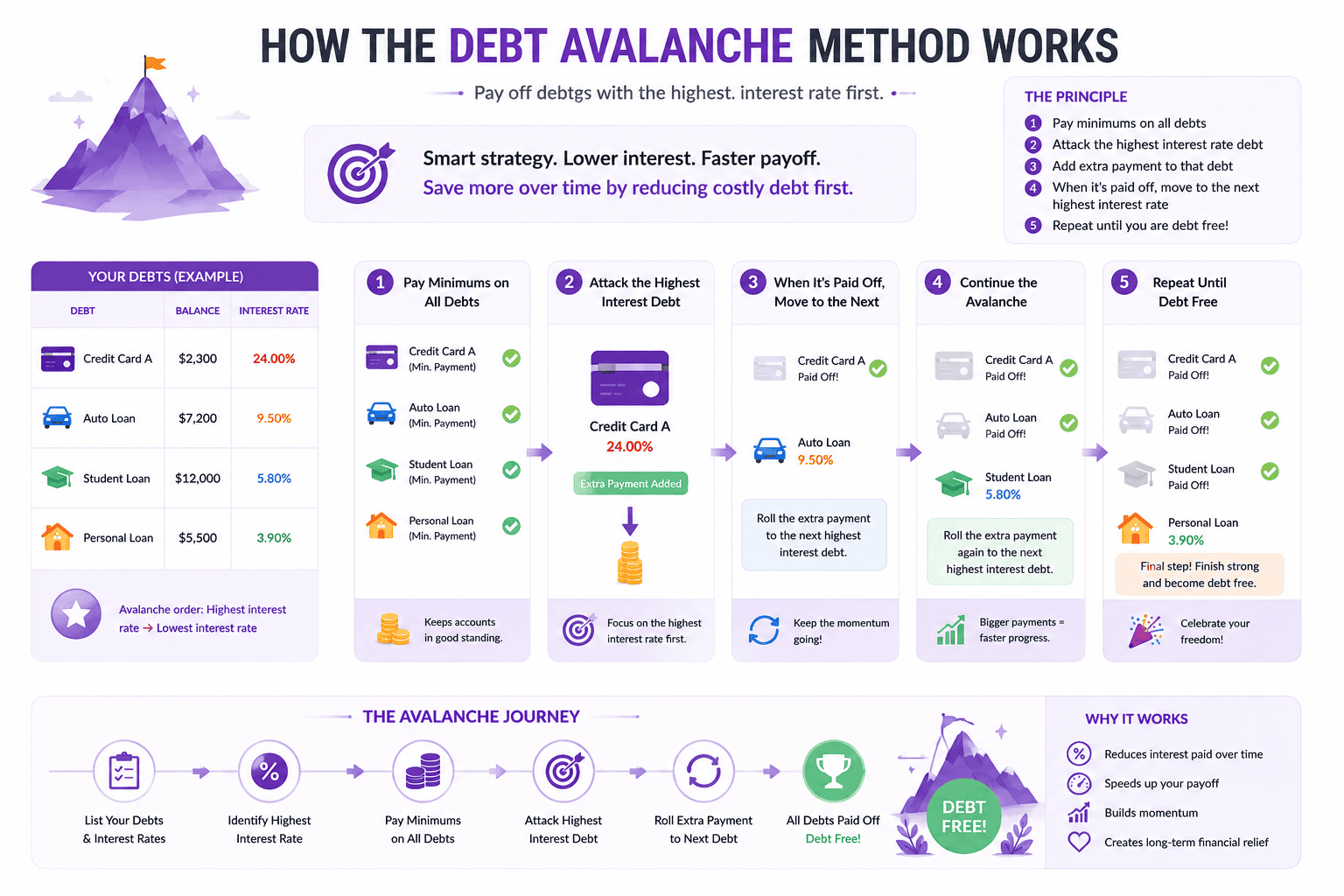
The debt avalanche method is a debt repayment strategy that prioritizes the debt with the highest interest rate first. You continue making the required minimum payments on your other debts while directing available extra money toward the highest-APR balance.
When the highest-interest debt is completely paid off, the payment that was being directed toward it is rolled into the next debt with the highest remaining interest rate. The process continues until all of the modeled debts are paid off.
The main reason people consider the avalanche strategy is mathematical: paying down higher-interest debt sooner can reduce the amount of interest that accumulates over time. However, the strategy does not guarantee a specific savings amount because the result depends on your balances, APRs, minimum payments, fees, and additional payments.
Identify the Highest APR
Rank your debts according to their annual percentage rates, from highest to lowest.
Maintain Minimum Payments
Continue paying at least the required minimum amount on your remaining debts.
Attack the Highest-Interest Debt
Direct your available extra payment toward the debt currently charging the highest APR.
Roll Payments Forward
Once a debt is eliminated, redirect its available payment toward the next-highest APR debt.
💡 Simple Example
Suppose you have three debts: a $1,000 balance at 24% APR, a $2,500 balance at 15% APR, and a $5,000 balance at 8% APR. Under a basic avalanche strategy, the $1,000 debt at 24% becomes the first target because it has the highest interest rate.
After that debt is paid off, the payment previously directed toward it can be combined with the available payment for the $2,500 debt at 15%. The process then continues toward the remaining debt with the highest APR.
⚖️ Potential Advantages and Trade-Offs
✅ Potential Benefits
- Prioritizes higher-interest debt.
- Can reduce interest accumulation when compared with other repayment orders.
- Provides a clear mathematical priority for multiple debts.
- May reduce the overall cost of borrowing when the assumptions remain consistent.
⚠️ Important Trade-Off
The highest-interest debt may also have a large balance, so it can take longer to eliminate than a small debt under the snowball method. Some people may find the slower early milestones less motivating.
🧮 Using the Debt Snowball vs Avalanche Calculator
A debt avalanche calculator can show how prioritizing high-APR balances may affect your estimated repayment timeline and interest cost. When you use the same debts and payment assumptions for both strategies, a debt snowball vs avalanche calculator makes the differences easier to evaluate instead of relying on general rules alone.
📌 A Practical Point to Remember
The avalanche method is often attractive when reducing interest cost is a major priority, but the best repayment strategy is not determined by APR alone. Your payment capacity, debt structure, fees, promotional rates, and ability to consistently follow the plan all matter.
Debt Snowball vs Debt Avalanche Calculator: What's the Difference?
Both the debt snowball and debt avalanche methods use the same basic idea: continue making the required payments on your debts while directing available extra money toward one priority debt at a time. The key difference is how that priority is selected.
The snowball method prioritizes the smallest balance, while the avalanche method prioritizes the highest interest rate. Because those priorities can produce different repayment orders, the total interest and payoff timeline can also differ.
| Comparison | ❄️ Debt Snowball | ⚡ Debt Avalanche |
|---|---|---|
| 🎯 First Priority | Smallest outstanding balance | Highest interest rate |
| 💰 Main Focus | Early payoff milestones | Reducing high-interest debt |
| 📉 Interest Cost | Can be higher depending on debt structure | Can be lower when higher APR debt is prioritized |
| 🏁 Early Wins | Often more frequent when small balances exist | May take longer if the highest-APR debt has a large balance |
| 🧠 Best Fit | People who value visible progress and simple milestones | People who prioritize mathematical interest savings |
When the Debt Snowball May Make Sense
The snowball approach may appeal to someone who wants to eliminate smaller balances quickly and see clear progress. If motivation and simple milestones are important factors in maintaining a repayment plan, paying off a small debt early can make the overall process feel more manageable.
When the Debt Avalanche May Make Sense
The avalanche approach may be attractive when minimizing interest costs is a major priority. By directing extra money toward the highest-APR debt first, the strategy focuses on the balances that can generate more interest relative to their outstanding amount.
🧮 What a Debt Snowball vs Avalanche Calculator Adds
General advice can tell you how each strategy works, but it cannot tell you exactly how the two approaches compare for your particular debts. A debt snowball vs avalanche calculator uses your balances, APRs, minimum payments, and extra payment amount to produce estimates for both repayment paths.
This lets you compare practical outcomes such as estimated payoff time, total interest, total payments, and the order in which your debts could be eliminated. The difference may be small for some debt combinations and substantial for others.
🔍 Example: Why the Result Can Change
Consider two debts: one has a $600 balance at 12% APR, while another has a $4,000 balance at 25% APR. The snowball method would normally target the $600 balance first because it is smaller. The avalanche method would target the $4,000 balance because it carries the higher interest rate.
Neither strategy can be judged correctly from the balances alone. The minimum payments, extra monthly amount, interest calculations, and payment timing also influence the final result. That is why running both strategies with the same assumptions can provide a more useful comparison.
⚠️ There Is No Universal Winner
The avalanche method can be mathematically advantageous when high-interest debt is prioritized, while the snowball method can provide earlier psychological milestones. The right choice depends on your actual debt structure and your ability to maintain the repayment plan. Use the calculator results as a comparison tool rather than treating one strategy as automatically correct for everyone.
How the Debt Snowball vs Avalanche Calculator Calculates Your Results
A debt snowball vs avalanche calculator compares two different debt repayment strategies using the same starting information. Instead of simply comparing your total debt, the calculator models how your balances, interest, minimum payments, and extra payments may change over time under each strategy.
The calculation starts with the same balance, APR, minimum payment, and extra monthly payment for both strategies. The main difference is the order in which the calculator directs available extra payments toward your debts.
Starting Balance
The calculator starts with the current balance entered for each debt.
APR
The annual percentage rate is used to estimate the interest added during each repayment period.
Minimum Payment
The required minimum payment for each debt is included in the monthly repayment calculation.
Extra Payment
Any additional monthly payment is directed toward the current priority debt based on the selected strategy.
❄️ How the Debt Snowball Calculation Works
With the debt snowball strategy, the calculator ranks debts from the smallest outstanding balance to the largest. Minimum payments continue on the other debts while available extra money is directed toward the smallest remaining balance.
When the smallest debt reaches a zero balance, the payment previously directed toward that debt becomes available for the next smallest debt. This payment rollover allows the amount directed toward later debts to increase as earlier balances are eliminated.
Example: If your debts have balances of $500, $2,000, and $6,000, the snowball strategy generally targets the $500 debt first. Once that balance is paid off, the available payment can roll toward the $2,000 debt.
⚡ How the Debt Avalanche Calculation Works
With the debt avalanche strategy, the calculator ranks debts from the highest APR to the lowest APR. Minimum payments continue on the other debts while available extra money is directed toward the debt with the highest interest rate.
Once the highest-interest debt reaches a zero balance, its available payment can be redirected toward the next debt with the highest remaining APR. The process continues until all modeled debts are paid off.
Example: If one debt has a 7% APR and another has a 24% APR, the avalanche strategy generally prioritizes the 24% debt, even when its balance is larger.
📅 What Happens During Each Month?
The calculator models the repayment process month by month rather than assuming that every payment produces the same result. A simplified calculation cycle includes the following steps:
📊 Why the Two Calculator Results Can Be Different
The snowball and avalanche strategies can produce different results because they prioritize different debts. The snowball approach focuses on the smallest balance first, while the avalanche approach focuses on the highest APR first. Depending on your debt balances and interest rates, one strategy may reduce individual balances sooner while the other may result in lower estimated interest.
The actual difference depends on your specific debt mix, minimum payments, interest rates, and extra payment amount. There is no fixed percentage of savings or repayment-time reduction that applies to everyone. Using the same debt information for both calculations provides a more meaningful comparison.
⚠️ Important Calculation Note
These results are estimates based on the information and payment assumptions entered into the calculator. Actual account results may differ because lenders can use different interest calculations, payment dates, statement cycles, fees, promotional rates, changing APRs, and account-specific terms. Use your lender statements and account terms for exact information.
How to Use the Debt Snowball vs Debt Avalanche Calculator
Using a debt snowball vs debt avalanche calculator is straightforward. The most important step is entering accurate and current information for each debt so the comparison reflects your repayment situation as closely as possible.
Add your debts, enter the balance, APR, and minimum payment for each one, then specify any extra amount you can pay each month. The calculator uses these inputs to compare the estimated results of the debt snowball and debt avalanche strategies.
1. Add Your Debts
Enter each debt separately. You can include credit cards, personal loans, student loans, or other debts included in your repayment plan.
2. Enter the Balance
Enter the current outstanding balance for each debt. Using the latest information from your lender or statement can improve the estimate.
3. Enter the APR
Enter the annual percentage rate shown by your lender. Check your latest statement or account terms if you are unsure of the current rate.
4. Enter Minimum Payment
Enter the required minimum monthly payment for each debt based on your current account information.
5. Add Extra Payment
Enter the additional amount you can realistically put toward your debts each month beyond the required minimum payments.
6. Compare Strategies
Review the modeled snowball and avalanche results to compare estimated payoff time, interest, total payments, and debt-free dates.
🔎 Where Should You Find the Numbers?
For a more useful estimate, use current information from your lender statements or online account. Look for the outstanding balance, APR or interest rate, and required minimum payment.
If an interest rate can change over time, such as with a variable-rate debt, the calculator's results should be treated as estimates rather than a guaranteed future repayment schedule.
📊 Review the Live Summary Before Comparing
Before comparing the two strategies, review the summary generated from your inputs. This can help you identify an incorrect balance, APR, minimum payment, or extra-payment amount before relying on the results.
💡 How to Get More Useful Results
Use Current Numbers
Older balances or outdated APRs can make the comparison less representative of your current debt situation.
Use a Realistic Extra Payment
A payment amount you can consistently maintain may be more useful than an aggressive amount that is difficult to sustain.
Run Different Scenarios
Try different extra-payment amounts to see how changes in your monthly payment could affect the estimated results.
Compare, Don't Assume
Compare the actual estimated differences in interest and payoff time instead of assuming one strategy will always be better.
⚠️ Keep Your Expectations Realistic
The calculator estimates repayment using the information you provide. It does not know about future purchases, late fees, changes in interest rates, missed payments, lender-specific policies, or changes to your income and budget. For that reason, the results should be used for planning and comparison rather than treated as a guaranteed debt-free date.
Understanding Your Debt Snowball vs Avalanche Results
After you enter your debts, the debt snowball vs avalanche calculator generates two repayment scenarios using the same starting information. The purpose is not to tell you that one method is universally correct, but to show how changing the order of repayment could affect your estimated timeline and interest cost.
Pay particular attention to the difference between total interest, estimated payoff time, and the amount of money you would need to commit each month. Looking at these numbers together gives you a more useful picture than focusing on a single result.
Total Interest
See the estimated interest accumulated during each modeled repayment strategy.
Payoff Time
Compare the estimated number of months required for each strategy to eliminate the modeled balances.
Debt-Free Date
The calculator estimates when your modeled debt could reach a zero balance based on the selected assumptions.
Strategy Difference
See how much the modeled outcomes differ between snowball and avalanche.
❄️ Reading the Debt Snowball Results
The snowball result shows what could happen when your smallest balance receives priority for additional payments. This approach can produce earlier account-level milestones because smaller debts may be eliminated sooner.
If the snowball calculation shows a higher total interest cost than the avalanche calculation, that does not mean the snowball method is "wrong." It means the modeled repayment order may result in interest accumulating on higher-rate balances for longer.
What to look for: Check when the first debt is estimated to disappear, how quickly subsequent debts are reduced, and whether the resulting payment milestones fit the way you prefer to manage your debt.
⚡ Reading the Debt Avalanche Results
The avalanche result prioritizes the debt with the highest APR. Mathematically, directing additional payments toward a higher-interest balance can reduce the amount of interest accumulating on that balance sooner.
For some debt combinations, the difference between the two strategies may be substantial. For others, the difference may be relatively small. The result depends on your balances, interest rates, minimum payments, and additional amount available for repayment.
What to look for: Compare the estimated total interest and payoff time against the snowball result. If the avalanche scenario saves money, the calculator should show the estimated difference rather than relying on a generic claim about how much you will save.
💡 How to Interpret the "Winning" Strategy
A strategy may appear to "win" because it produces a lower modeled interest cost or a shorter payoff period. However, the mathematically cheaper strategy is not automatically the best choice for every person.
For example, someone who values quick psychological milestones may prefer the snowball approach even when the avalanche method produces lower estimated interest. Another person may prioritize minimizing borrowing costs and therefore prefer avalanche.
The most useful comparison is therefore based on your priorities, your ability to maintain the payment plan, and the actual numbers generated from your debt information.
Lower Interest
If minimizing modeled interest is your primary goal, compare the total interest figures carefully.
Faster Payoff
Compare the estimated months to debt-free status rather than assuming the two methods always finish at the same time.
Personal Preference
A strategy you can consistently follow may be more useful than one that looks better mathematically but is difficult to maintain.
📈 Use the Charts to See the Difference
The visual charts can make differences easier to understand than numbers alone. Look for how quickly the total remaining balance falls, when individual debts reach zero, and how the estimated interest compares between the two repayment strategies.
The monthly schedule provides another useful view. It shows how payments, interest, principal reduction, and remaining balances can change throughout the modeled repayment period.
🔍 A Better Way to Read the Results
See which strategy produces the lower modeled interest cost.
Compare the estimated number of months and debt-free dates.
Look at when individual debts are expected to be eliminated.
Choose a repayment approach that fits your actual budget and behavior.
⚠️ Remember: Estimates Are Not Guarantees
The results depend on the assumptions and information entered into the calculator. Actual debt repayment can differ because of interest-rate changes, fees, new charges, payment timing, missed payments, lender policies, or changes in the amount you can afford to pay. Always verify account-specific information with your lender.
Benefits of Using a Debt Snowball vs Debt Avalanche Calculator
Comparing multiple debts can be difficult when balances, interest rates, and minimum payments all vary. A debt snowball vs debt avalanche calculator puts the same debt information into two repayment models, making it easier to understand how each strategy may affect your estimated payoff timeline and interest cost.
The value of the comparison is not simply finding a "winner." It is understanding the potential trade-offs between interest cost, payoff time, payment allocation, and the order in which individual debts could be eliminated.
Compare Both Strategies
Compare the snowball and avalanche approaches using the same balances, APRs, minimum payments, and extra monthly payment.
Estimate Interest Costs
See how changing the repayment priority may affect the estimated interest accumulated during the modeled payoff period.
Understand Payoff Time
Compare the estimated number of months needed to eliminate the debts under each modeled repayment strategy.
See Debt-Free Dates
View an estimated debt-free date based on the payment assumptions and repayment timeline used by the calculator.
Test Extra Payments
Experiment with different additional monthly payment amounts to see how they may change the modeled payoff results.
Make the Trade-Off Visible
See whether the estimated difference between strategies is mainly related to interest cost, payoff timing, or debt elimination order.
💵 See the Potential Cost of Different Repayment Orders
Two repayment strategies can use the same monthly budget but produce different interest outcomes because extra payments are directed toward different debts. This difference can become more noticeable when the debts have significantly different APRs.
The calculator makes this difference easier to evaluate by modeling the estimated interest for each strategy rather than assuming that one repayment method will always produce the same result for every debt situation.
Example: If one debt has a substantially higher APR than your other balances, the avalanche model may show a larger estimated interest advantage. If your APRs are relatively similar, the estimated difference between the two strategies may be smaller.
🏁 Turn a Large Debt Plan Into Smaller Milestones
Managing several debts can feel complicated because there are multiple balances, interest rates, and required payments to consider. The snowball strategy creates a clear repayment order by directing extra money toward the smallest balance first.
The calculator can show the projected order in which debts could be eliminated and how payment rollovers affect later balances. This makes the repayment process easier to visualize without assuming that one strategy will be more motivating for everyone.
🔄 Explore "What If" Scenarios
A useful repayment calculator should also help you understand how changes in your payment plan could affect the outcome. You can test different extra-payment amounts and compare how those changes affect the estimated timeline and interest cost.
Increase Your Payment
See whether adding a modest amount to your monthly payment changes the estimated payoff timeline.
Reduce Extra Payment
Understand how a smaller additional payment could affect the modeled debt-free date and interest cost.
Compare Priorities
Compare how changing the repayment priority can change the sequence in which your debts are modeled as paid off.
🧠 Support Better Repayment Decisions
A calculator cannot determine which repayment strategy is right for your household. Its purpose is to make the numerical differences easier to understand so you can evaluate the options according to your own financial priorities and circumstances.
If the avalanche strategy shows lower estimated interest while the snowball strategy provides earlier payoff milestones, the decision involves more than mathematics. Your budget, consistency, financial goals, and ability to maintain the repayment plan can all influence which approach is practical for you.
🔍 What This Calculator Helps You See
Compare the estimated interest accumulated under each repayment strategy.
Compare the estimated number of months required to eliminate the modeled debt.
Review the estimated order and timing of individual debt payoffs.
Test different extra-payment amounts and compare their modeled effects.
⚠️ Use the Results as a Planning Tool
The calculator provides estimates based on the information entered. Actual results can differ because of lender-specific payment rules, fees, interest calculation methods, payment timing, future transactions, changes in interest rates, or missed payments. Use the results to understand and compare repayment scenarios, and verify important account details with your lenders.
Debt Snowball vs Debt Avalanche: Which Strategy Fits Your Goals?
The debt snowball vs debt avalanche comparison comes down to how you prioritize your debts. Both methods require you to keep making the required minimum payments while directing available extra money toward a specific priority debt.
The key difference is simple: debt snowball prioritizes the smallest balance, while debt avalanche prioritizes the highest APR. That difference can change the order in which your debts disappear and, depending on your numbers, the total interest paid.
Debt Snowball
Focus your extra payment on the debt with the smallest current balance, regardless of its interest rate.
Debt Avalanche
Focus your extra payment on the debt with the highest APR, regardless of its current balance.
🔍 Debt Snowball vs Avalanche: Key Differences
| Factor | ❄️ Snowball | ⚡ Avalanche |
|---|---|---|
| Priority | Smallest balance | Highest APR |
| Primary focus | Quick account-level milestones | Interest efficiency |
| First payoff | Often targets a smaller debt | Targets the highest-rate debt |
| Interest cost | Can be higher depending on debt rates | Often lower when APRs differ significantly |
| Best fit may depend on | Motivation and visible progress | Interest-cost priorities |
💰 When Avalanche May Save More Interest
Suppose you have several debts and one of them carries a substantially higher APR than the others. With the avalanche method, your extra payment is directed toward that expensive debt first. This can reduce the amount of high-rate debt remaining over the course of the modeled repayment period.
That does not mean the avalanche method will produce a dramatic saving in every situation. If your interest rates are close together, the calculated difference may be relatively small. Your actual numbers matter more than a general rule.
🏁 When Snowball May Feel Easier to Follow
Snowball can be attractive when seeing a debt reach zero quickly provides useful motivation. Eliminating a smaller balance can create a clear milestone and reduce the number of accounts you are actively managing.
This behavioral benefit is difficult to express as a percentage or score because motivation is personal. The calculator therefore focuses on measurable outcomes rather than assigning an arbitrary "debt health" or confidence score.
Think in terms of fit, not a universal winner. Avalanche may be mathematically attractive when reducing interest is your main priority. Snowball may be attractive when quick, visible debt milestones help you stay committed. Your calculator results show the numerical trade-offs for the debts you entered.
🧮 Why Your Numbers Matter More Than General Advice
Online debt advice often presents snowball and avalanche as a simple choice between "motivation" and "mathematics." Real debt situations are more varied. The size of each balance, APR, minimum payment, and extra payment amount can all influence the modeled outcome.
For that reason, this calculator does not promise that one strategy will always save a specific amount of money or a specific number of months. Instead, it calculates the difference using the information you provide.
🎯 A Practical Way to Choose
Start by looking at the calculator's estimated interest difference. Then compare the payoff timelines and individual debt milestones. Finally, consider whether the strategy is realistic for your monthly budget.
If the estimated difference is small, choosing the method you are more likely to follow consistently may be reasonable. If the difference is large, the potential financial impact may deserve greater attention.
Real-Life Uses for a Debt Snowball vs Debt Avalanche Calculator
Debt repayment rarely looks like a perfectly organized spreadsheet. You may have a credit card balance, a personal loan, a student loan, a medical bill, or another debt with a different interest rate and minimum payment. When several balances exist at the same time, deciding where to direct extra money can become confusing.
A debt snowball vs debt avalanche calculator can help turn that collection of balances into a clearer repayment scenario. Here are some practical situations where comparing the two methods may be useful.
Multiple Credit Cards
If you have several credit card balances with different APRs, the calculator can show how prioritizing the smallest balance compares with targeting the highest-rate card.
Several Personal Debts
You can model multiple installment or revolving debts together to understand how the repayment order may affect the overall timeline.
Planning an Extra Payment
If your monthly budget allows an additional payment, test different amounts to see how the modeled payoff timeline and interest could change.
Setting a Debt-Free Goal
Use the estimated payoff date to understand how your current repayment commitment could translate into a future debt-free milestone.
Comparing Repayment Plans
If you are deciding between snowball and avalanche, use the same debt information in both scenarios and compare the resulting numbers.
Budget Review
Before committing to an extra payment amount, model a few realistic scenarios to see what may fit your available monthly budget.
💳 Example: Managing Several Credit Card Balances
Imagine someone has three credit cards: one with a small balance and moderate APR, another with a medium balance and high APR, and a third with a larger balance and a lower APR. They can make all required minimum payments and have some additional money available each month.
The snowball calculation would prioritize the smallest balance, while the avalanche calculation would prioritize the card with the highest APR. The resulting schedules can then be compared to see how much the repayment order changes the estimated interest and payoff timeline.
The important point: You do not need to guess which difference matters. Enter the actual balances, APRs, minimum payments, and extra payment amount to see the modeled comparison for your situation.
➕ Example: Deciding How Much Extra to Pay
You may know that you want to pay more than the required minimum, but you may not know whether an additional $50, $100, or $200 per month would make a meaningful difference.
A what-if comparison can help you see how different extra payment amounts affect the modeled payoff period. This can be useful when creating a monthly budget because it lets you compare potential outcomes before choosing a payment target.
🏁 Example: Staying Motivated During Debt Repayment
For some people, a repayment plan is easier to maintain when they can see individual debts disappearing. In that situation, the snowball approach may provide useful short-term milestones because it targets smaller balances first.
The calculator can show those projected milestones without claiming that everyone will benefit from the same psychological approach. Whether those milestones are motivating is ultimately a personal decision.
📉 Example: Prioritizing High-Interest Debt
Someone with a particularly high-interest balance may want to understand the potential cost of leaving that balance outstanding while paying down another debt first.
The avalanche scenario addresses this by prioritizing the highest APR. Comparing it with the snowball result can show whether that repayment order produces a meaningful difference in the modeled interest cost for the debts entered.
🧠 Questions to Ask After Running Your Calculation
Compare the estimated total interest rather than assuming the difference will always be large.
Check whether one modeled strategy reaches zero sooner.
Review the payoff order and individual debt milestones.
Make sure the monthly payment assumption is sustainable for your actual budget.
⚠️ Important for Real-World Debt Planning
A calculator models the assumptions you provide. It cannot predict future interest-rate changes, new purchases, fees, missed payments, lender policy changes, or changes in your income and expenses. Treat the results as an estimate for planning and comparison, not as a guarantee of what will happen to your accounts.
How to Pay Off Debt Faster With a Debt Snowball or Debt Avalanche Strategy
Choosing between the debt snowball and debt avalanche is only one part of a successful repayment plan. The amount you consistently pay, the interest rates on your debts, and whether you continue adding new balances can have a major effect on your progress.
The goal is not simply to choose the strategy that looks best on paper. A useful debt repayment plan should also be realistic enough to maintain month after month. The following practical steps can help you make better use of the calculator and your repayment plan.
1. List Every Debt
Start with an accurate list of your balances, APRs, minimum payments, and any other information required by the calculator. Missing or outdated numbers can make the comparison less useful.
2. Choose a Clear Priority
Use snowball if you want to prioritize the smallest balance, or avalanche if your main objective is to prioritize the highest APR.
3. Find a Sustainable Extra Payment
Even an additional amount may change the modeled repayment timeline. However, choose an amount that your budget can realistically support.
4. Avoid Adding New Debt
A repayment plan becomes harder to follow when new balances continue to replace the debt being paid down. Consider whether new borrowing is necessary before adding expenses to a revolving account.
5. Review Your Progress Regularly
Balances, interest rates, and budgets can change. Recheck your repayment plan when your financial circumstances change rather than assuming the original projection will remain accurate.
6. Compare the Actual Numbers
Look at estimated interest, payoff time, and debt order. Do not choose a strategy simply because it is commonly recommended online.
💰 Paying More Than the Minimum
One of the most useful things you can test with a debt repayment calculator is the effect of an additional monthly payment. Increasing the amount paid toward debt can reduce the balance faster, which can also reduce the amount of interest that accumulates over time.
Instead of assuming that a large payment is necessary, try several realistic amounts. For example, you could compare your current plan with scenarios that add a modest amount, a moderate amount, and a larger amount. This gives you a clearer view of the trade-off between monthly cash flow and estimated repayment time.
Do not overextend your budget just to reach a faster projected date. A payment plan that is technically faster but impossible to maintain may be less useful than a slightly slower plan that you can consistently follow.
📊 Use the Calculator for What-If Scenarios
Debt repayment involves decisions, and those decisions can be easier when you can compare scenarios rather than relying on a single estimate. Use the calculator to test reasonable changes to your repayment plan.
📉 Pay Attention to High-Interest Balances
Interest rates deserve particular attention when comparing repayment strategies. A balance with a significantly higher APR can accumulate interest more quickly than a similar balance with a lower rate.
This is one reason the debt avalanche method can produce lower modeled interest in some situations. However, the actual difference depends on the balances, APRs, minimum payments, and repayment assumptions entered into the calculator.
🧠 Choose Consistency Over an Unrealistic Plan
A debt repayment strategy is useful only if you can follow it. If an aggressive payment leaves too little money for essential expenses or unexpected costs, the plan may not be sustainable.
Consider your broader monthly budget before increasing debt payments. The calculator can show what happens mathematically, but it cannot determine whether a particular payment amount is appropriate for your personal financial circumstances.
✅ A Simple Debt Repayment Checklist
⚠️ Remember: Faster Is Not Always Better
The fastest modeled payoff date is not automatically the best financial choice for every person. Your emergency savings, essential expenses, income stability, interest rates, and other financial obligations also matter. Use the calculator as a planning tool and consider your complete financial situation before changing your repayment strategy.
Why Use the AIToolKitCenter Debt Calculator?
Choosing a debt repayment strategy should not require complicated spreadsheets or calculations by hand. The Debt Snowball vs Debt Avalanche Calculator is designed to make the comparison easier by turning the debt information you provide into a clear repayment model.
Instead of telling you that one strategy is automatically better, the calculator focuses on measurable results. You can compare estimated payoff time, total interest, repayment order, and other available details based on the assumptions entered.
This approach is important because personal debt situations are different. A strategy that produces the lowest modeled interest for one set of balances may not produce the same result for another. Showing the underlying numbers gives you more useful information than an arbitrary score or unsupported financial claim.
Transparent Comparisons
See the modeled differences between snowball and avalanche rather than relying on a generic recommendation.
Useful Analytics
Focus on practical figures such as estimated interest, payoff time, payment progress, and debt order.
Privacy-Focused
The calculator is designed to perform calculations in your browser without requiring you to submit financial information to an external service.
Designed for Modern Devices
The interface is designed to remain usable across desktop, tablet, and mobile screen sizes.
Scenario-Based Planning
Test different repayment assumptions and see how changing your inputs can affect the modeled outcome.
Actionable Results
The goal is to help you understand your numbers so you can make a more informed repayment decision.
⚙️ Built Around Your Inputs
The quality of a repayment estimate depends heavily on the information entered. That is why the calculator is designed around your individual debt balances, APRs, minimum payments, and available extra payment rather than presenting a one-size-fits-all result.
When your circumstances change, you can update the inputs and run the comparison again. This makes the tool useful for exploring different repayment scenarios rather than treating one calculation as a permanent financial plan.
💡 What You Can Learn From the Results
🛡️ Accuracy, Transparency & Responsible Use
AIToolKitCenter does not claim that a calculator can predict the exact future of a debt account. Actual interest charges, minimum payments, fees, payment posting dates, promotional rates, lender policies, and other account conditions can affect real repayment results.
For that reason, the results should be treated as estimates for educational and planning purposes. Before making a significant financial decision, review the terms of your individual accounts and consider obtaining appropriate professional financial advice when necessary.
Our approach: Provide useful calculations, explain the assumptions, avoid invented scores and unsupported promises, and let the numbers help you evaluate the available repayment strategies.
💜 AIToolKitCenter creates practical online tools designed to make complex calculations easier to understand and use.
Debt Snowball vs Debt Avalanche Calculator FAQs
These frequently asked questions explain how the debt snowball vs debt avalanche calculator works, how the two repayment strategies differ, and how to interpret the estimates produced by the tool.
❄️ What is the debt snowball method?
The debt snowball method prioritizes the debt with the smallest outstanding balance while you continue making the required minimum payments on your other debts. Once the smallest debt is paid off, the payment amount that was being used for it can be redirected toward the next priority debt.
⚡ What is the debt avalanche method?
The debt avalanche method prioritizes the debt with the highest annual percentage rate (APR). The required minimum payments continue on the other debts, while available extra money is directed toward the highest-rate balance first.
⚖️ Is debt snowball or debt avalanche better?
There is no universal answer. Avalanche can be advantageous when minimizing interest is the main priority, while snowball can provide earlier individual debt milestones. The best choice depends on your balances, APRs, payment amounts, budget, and ability to consistently follow the strategy.
💰 Does the debt avalanche method always save more money?
Not necessarily in every practical situation. When comparing the same debts, payment assumptions, and repayment period, prioritizing the highest APR generally targets the debt where interest is accruing at the highest rate. However, the actual difference depends on the numbers entered and the assumptions used by the calculator.
📊 What information do I need to use the calculator?
You generally need the current balance, APR, and required minimum payment for each debt. You may also need to enter the amount of extra money available for debt repayment, depending on the calculator's inputs and selected strategy.
➕ Does paying extra each month help pay off debt faster?
Generally, paying more than the required amount reduces the outstanding principal faster, assuming the additional payment is applied toward the debt. A lower balance can reduce future interest charges and shorten the modeled repayment period. The exact effect depends on the debt terms and payment assumptions.
📅 Can the calculator tell me my exact debt-free date?
No. The calculator provides an estimated debt-free date based on the information and assumptions entered. Actual dates can change because of interest calculations, fees, payment posting dates, new charges, rate changes, missed payments, and lender-specific policies.
🔄 Can I compare different repayment scenarios?
Yes. You can use the calculator to compare the modeled outcomes of snowball and avalanche strategies using the same debt information. If the tool supports additional payment or custom-priority scenarios, those can also be useful for testing different repayment approaches.
🔒 Is my financial information uploaded when I use the calculator?
The calculator is designed to perform its calculations in your browser and does not require an account or an external financial-data connection. Avoid entering sensitive information that the calculator does not specifically require.
🧮 Why are my calculator results different from my credit card statement?
A calculator uses a defined mathematical model based on the information you provide, while your lender may calculate interest, minimum payments, fees, and payment timing differently. Statement balances can also include new purchases, fees, promotional rates, or other account activity that is not included in the model.
📉 Can the debt snowball reduce interest costs?
It can reduce the overall repayment period when followed consistently, but snowball does not specifically prioritize interest rates. If a higher-APR debt is left for later, the modeled total interest may be higher than an avalanche strategy using the same payment assumptions.
🎯 Should I always choose the strategy with the shortest payoff time?
Not automatically. Consider total interest, monthly affordability, your repayment priorities, and whether you can maintain the plan. A slightly different projected timeline may be less important than choosing a strategy you can realistically follow.
⚠️ Are the results financial advice?
No. The calculator provides estimates for educational and planning purposes. It does not know your complete financial circumstances or the specific terms of every account. Review your lender's terms and consider qualified professional advice when making significant financial decisions.
💡 Quick takeaway: Snowball and avalanche are both structured debt repayment methods. The most useful comparison is not a generic claim about which method is "best," but the actual difference in payoff time, interest, and debt order produced by your own numbers.
Debt Snowball vs Debt Avalanche Calculator Disclaimer
The Debt Snowball vs Debt Avalanche Calculator is provided for general educational, informational, and financial planning purposes only. The results are estimates generated from the information and assumptions you enter into the calculator.
The calculations should not be considered personalized financial, investment, legal, tax, credit, or debt-management advice. A calculator cannot evaluate your complete financial circumstances, obligations, income, expenses, credit agreements, or personal goals.
⚠️ Why Actual Results May Differ
Actual debt repayment results can differ from calculator estimates because lenders and creditors may use different methods for calculating interest, minimum payments, fees, payment posting dates, promotional rates, and other account terms.
New purchases, balance transfers, cash advances, late payments, changes in interest rates, additional fees, or changes to your monthly payment can also affect the actual repayment timeline and total cost.
🧮 About the Calculator Estimates
The calculator compares repayment strategies using the inputs you provide. It does not have access to your bank, credit card issuer, loan servicer, credit report, or other financial accounts.
An estimated payoff date, interest amount, savings figure, or repayment period should therefore be treated as a model rather than a guarantee of future results.
💼 When Professional Advice May Help
If you are experiencing serious financial difficulty, considering debt settlement or bankruptcy, dealing with collection activity, or making a significant financial decision, consider speaking with a qualified financial professional, credit counselor, attorney, or other appropriate adviser.
Professional guidance may be especially important when your situation involves circumstances that a general calculator cannot model.
💜 AIToolKitCenter's commitment: We aim to provide transparent calculators that explain their purpose and limitations rather than making guarantees about financial outcomes. Always verify important figures against your actual account statements and terms.
Last updated: August 2026 · For educational and planning purposes only.
Explore More Useful Tools
Looking for more free tools for everyday tasks? Explore our collection of practical calculators, converters, PDF utilities, and image tools designed to help you complete common tasks quickly and easily.
📄 PDF & Document Tools
🖼️ Image Tools
🔄 Converter Tools
💼 Freelancer & Income Tools
💳 CREDIT CARD RESOURCES
Looking for more practical information about credit card repayment? Explore our credit card repayment resources for additional guidance and planning information.
💜 Explore more practical tools from AIToolKitCenter for calculations, conversions, documents, images, and everyday online tasks.
About the Author: This tool and guide are created by the AIToolkitCenter team, focused on building simple, accurate, and user-friendly online tools for global users.